
Learn where asbestos is commonly found, how exposure happens, and why professional testing is the only reliable way to confirm its presence.
Asbestos was widely used across the United States for decades in construction materials, insulation systems, and industrial applications. While its use has declined, millions of homes, buildings, and job sites may still contain asbestos today.
One of the most common misconceptions is simple but dangerous: you cannot reliably identify asbestos just by looking at a material. Many asbestos-containing products look nearly identical to products that do not contain asbestos.
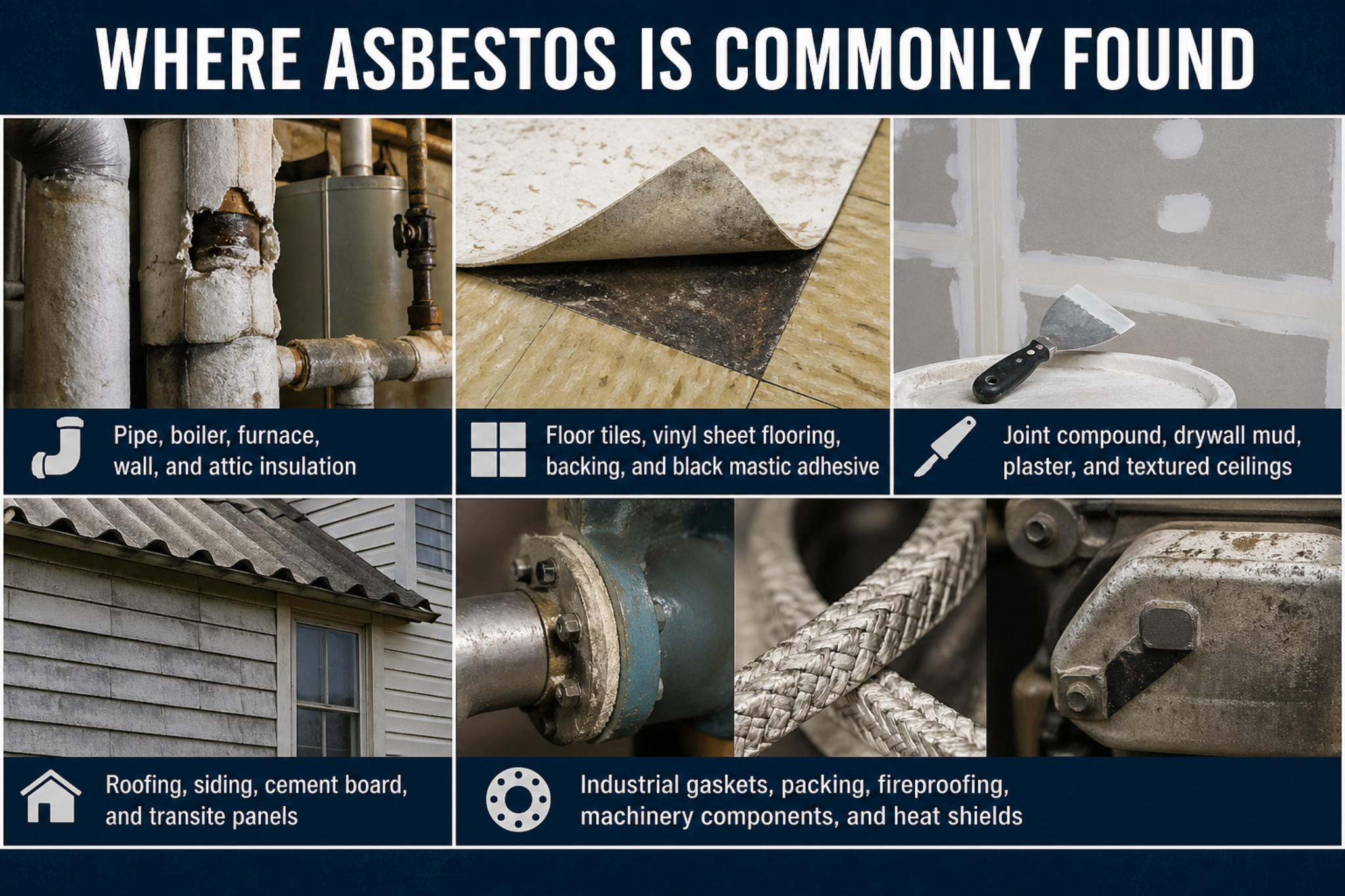
Asbestos is most dangerous when fibers become airborne. This can happen when materials are cut, sanded, drilled, broken, removed, or demolished. Once airborne, fibers can be inhaled and may remain in the body for decades.
A trained professional evaluates the material type, location, age, and condition.
Small samples are collected using procedures designed to reduce unnecessary disturbance.
Samples are tested by a qualified lab using methods such as PLM or TEM to identify asbestos fibers.
The report identifies whether asbestos is present and may include recommendations for next steps.