
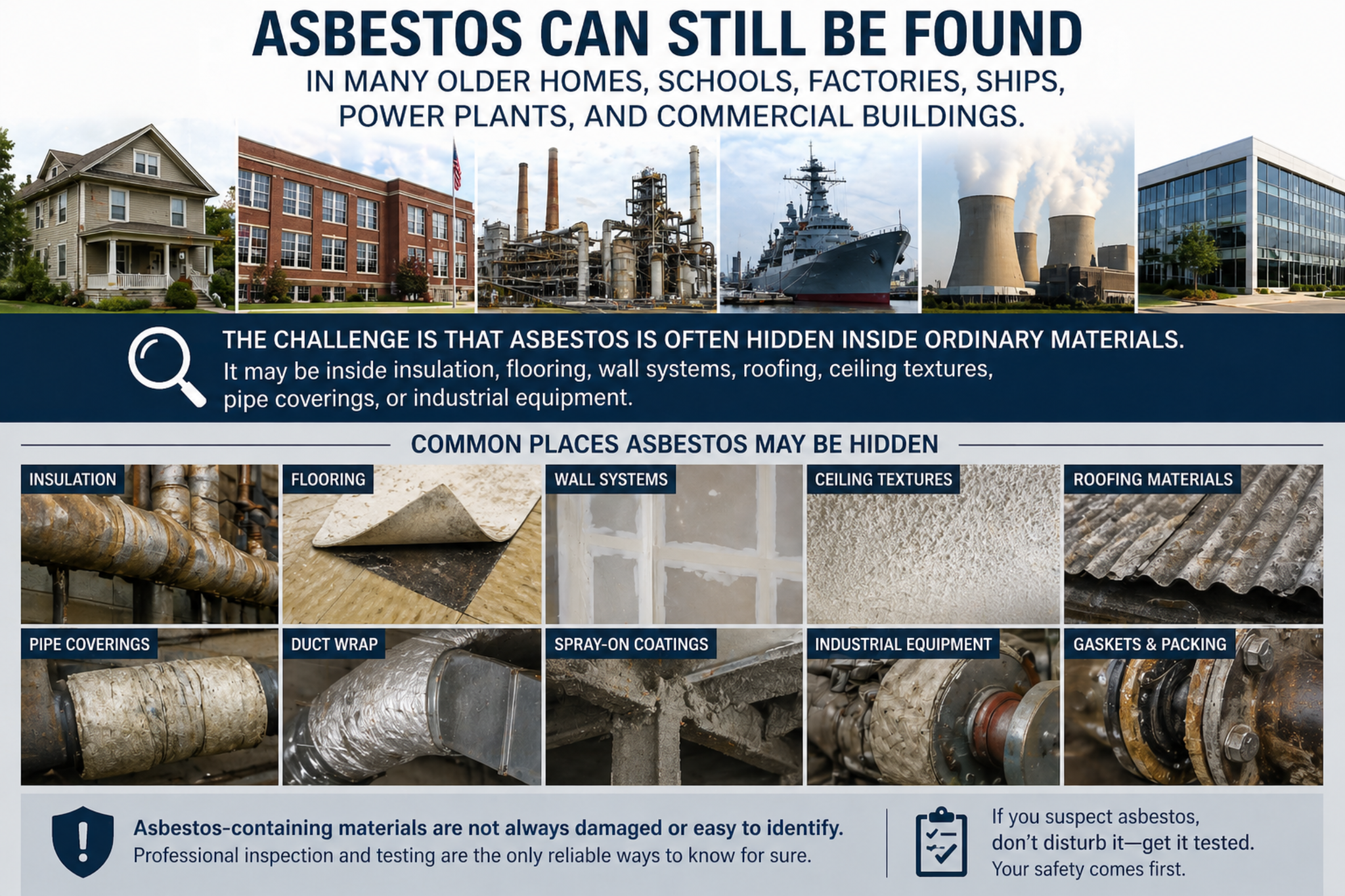
Asbestos can still be found in many older homes, schools, factories, ships, power plants, and commercial buildings.
The challenge is that asbestos is often hidden inside ordinary materials. It may be inside insulation, flooring, wall systems, roofing, ceiling textures, pipe coverings, or industrial equipment.
Asbestos resisted heat, fire, chemicals, friction, wear, and corrosion. That made it useful in construction, manufacturing, shipbuilding, power generation, and many industrial trades.
Pipe insulation, boiler insulation, duct insulation, furnace insulation, tank insulation, and some attic insulation products.
Older vinyl tiles, sheet flooring, backing, black mastic adhesive, and underlayment materials.
Joint compound, drywall mud, plaster, textured ceilings, popcorn ceilings, ceiling tiles, and patching compounds.
Roofing shingles, felt, flashing, siding, cement board, transite panels, adhesives, and sealants.
Industrial environments often had multiple asbestos-containing materials in one facility, including pipe insulation, gaskets, valve packing, boiler insulation, turbine insulation, fireproofing, electrical components, and heat shields.
Engine rooms, boiler rooms, pipe chases, insulation removal zones, naval vessels, and cargo ships.
Demolition, renovation, drywall work, flooring removal, roofing, pipe work, HVAC work, and insulation work.
Boilers, turbines, pipe insulation, gaskets, pumps, valves, heat-resistant panels, and shutdown maintenance work.
Steel mills, chemical plants, refineries, automotive plants, paper mills, textile mills, machine shops, and foundries.
Family members may have been exposed when asbestos dust was carried home on work clothing, boots, hair, tools, vehicles, or laundry.
No. Visual inspection alone is not reliable. Laboratory testing is needed to confirm whether asbestos is present.